
What Is a Terminal Block? A Beginner's Guide | SafetyPass
What Is a Terminal Block? A Beginner's Guide
By the Antong Engineering Team · Reviewed August 2026 · 9 min read
What Is a Terminal Block? The short definition is only the beginning: a usable specification must also identify the current path, conductor interface, insulation, dimensions, mounting and approval conditions.
For students, beginners and non-engineers, that distinction affects initial design, purchasing, assembly and later maintenance. This guide follows the original brief from construction through ratings, applications and practical checks so the same evidence can support the RFQ, sample approval and inspection record.
From more than 35 years of manufacturing terminal blocks, the consistent lesson is that reliability comes from matching the complete application rather than one attractive number. IEC 60947-7-1 defines terminal blocks for copper conductors as assemblies carried by insulating parts and fixed to a support.
Quick answer: A terminal block is an insulated component that joins conductors through a metal current path and a mechanical clamp. It makes wiring organized, inspectable and serviceable, provided the exact block matches the current, voltage, wire, environment, mounting and applicable certification requirements.
In this guide
Terminal Block Definition in Plain Language
Evaluating terminal block definition in plain language requires both product data and installed conditions. Keep each catalog value paired with the exact model, conductor, mounting and approval to which it applies.
What it does: connects two or more wires safely
The datasheet or drawing should identify what it does and state connects two or more wires safely. Keep wire size, conductor class and termination method on one datasheet row. If two conductors or a lug are involved, verify that exact combination instead of relying on physical fit. Do not copy the value from a neighboring series unless the manufacturer documents the same construction and approval.
Why not just twist wires together?
Check the bare or ferruled diameter, strip length and insertion depth with the production wire. A nominal mm² or AWG value does not describe strand class or crimp geometry. Do not copy the value from a neighboring series unless the manufacturer documents the same construction and approval.
Basic Parts of a Terminal Block
Evaluating basic parts of a terminal block requires both product data and installed conditions. Keep each catalog value paired with the exact model, conductor, mounting and approval to which it applies.
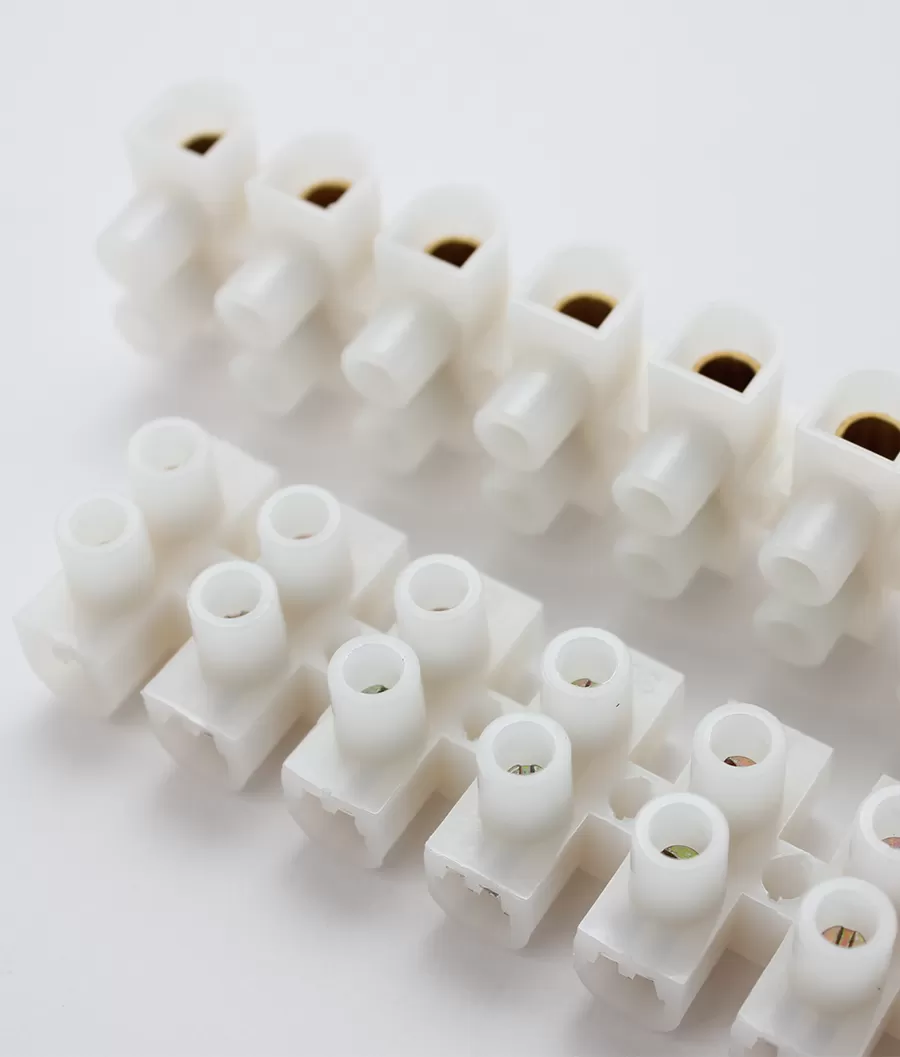
The insulating body (plastic)
The drawing should show the insulating body, conductive path, clamp and mounting as one assembly. Material and geometry changes can affect both mechanical fit and temperature-rise performance. The terminal is serviceable because conductors can be removed without cutting a permanent splice.
The metal conductor inside
Check the bare or ferruled diameter, strip length and insertion depth with the production wire. A nominal mm² or AWG value does not describe strand class or crimp geometry. Do not copy the value from a neighboring series unless the manufacturer documents the same construction and approval. For this requirement, the approval record should explicitly address the metal conductor inside.
The screw or spring that holds the wire
Evaluate the actual conductor construction and prepared end, not only its nominal gauge. The approved range can differ for solid, stranded, fine-stranded, ferruled and multi-conductor combinations. Keep the evidence with the drawing and sample record so purchasing cannot substitute a similar-looking part.
Practical Selection Summary
| Decision area | What to verify | Why it matters |
|---|---|---|
| Terminal Block Definition in Plain Language | What it does: connects two or more wires safely; Why not just twist wires together? | Defines the product function |
| Basic Parts of a Terminal Block | The insulating body (plastic); The metal conductor inside | Controls fit and installation |
| Where Terminal Blocks Are Used | Inside electrical panels; In appliances and machines | Affects rating and service life |
| Why Professionals Use Them | Safety: controlled insulation and touch protection; Serviceability: easy to disconnect and reconnect | Prevents purchasing substitutions |
| A Quick Look at Common Types | Brief intro to screw, spring, and DIN rail types with photos | Supports inspection and maintenance |
Use this table as an RFQ checklist; the exact datasheet remains controlling.
Where Terminal Blocks Are Used
Treat where terminal blocks are used as an engineering check rather than a catalog label. Define the requirement, identify the governing rating and verify it on the exact product variant.
Inside electrical panels
State the requirement in terms that engineering, purchasing and inspection can all verify. If the catalog does not provide the needed value, request a drawing or test record before approval. IEC 60947-7-1 defines terminal blocks for copper conductors as assemblies carried by insulating parts and fixed to a support.
In appliances and machines
Start with the real duty cycle and enclosure environment, then map the application to conductor, rating, mounting and maintenance requirements. The industry label alone cannot approve the part. Confirm the result on a production-representative sample before releasing tooling or volume orders.
In building wiring
Use the point to eliminate unsuitable variants, then confirm the remaining choice on the exact datasheet and sample. Similar naming is not evidence of equivalent construction. Confirm the result on a production-representative sample before releasing tooling or volume orders.
Why Professionals Use Them
The decisions under why professionals use them affect first-time assembly and long-term maintenance. Document them in the bill of materials and installation instructions instead of leaving them to operator judgment.
Safety: controlled insulation and touch protection
The datasheet or drawing should identify safety and state controlled insulation and touch protection. State the requirement in terms that engineering, purchasing and inspection can all verify. If the catalog does not provide the needed value, request a drawing or test record before approval. The terminal is serviceable because conductors can be removed without cutting a permanent splice.
Serviceability: easy to disconnect and reconnect
The datasheet or drawing should identify serviceability and state easy to disconnect and reconnect. Reliability must be evaluated over vibration, thermal cycling and service operations, not only at initial installation. Follow the declared inspection and maintenance instructions for the exact connection technology. Do not copy the value from a neighboring series unless the manufacturer documents the same construction and approval.
Organization: neat, labeled wiring
The datasheet or drawing should identify organization and state neat, labeled wiring. State the requirement in terms that engineering, purchasing and inspection can all verify. If the catalog does not provide the needed value, request a drawing or test record before approval. Confirm the result on a production-representative sample before releasing tooling or volume orders.
A Quick Look at Common Types
Evaluating a quick look at common types requires both product data and installed conditions. Keep each catalog value paired with the exact model, conductor, mounting and approval to which it applies.
Brief intro to screw, spring, and DIN rail types with photos
Connection reliability comes from controlled contact force and a clean interface. Match the wire preparation and operating method to the exact clamp rather than tightening or pushing by feel. IEC 60947-7-1 defines terminal blocks for copper conductors as assemblies carried by insulating parts and fixed to a support.
Related guidance: Terminal Block Types: The Complete Guide with Pictures and What Is a DIN Rail Terminal Block? Types, Mounting & Sizes.
FAQ: Frequently Asked Questions
Are terminal blocks safe?
They are safe when correctly selected, approved and installed within their current, voltage, conductor, torque, temperature and enclosure limits. A terminal block does not correct an undersized wire, exposed live part or poor installation.
What is the difference between a terminal block and a connector?
A connector is the broad category; a terminal block is one connector type intended for terminated and inspectable wiring. Pluggable terminal blocks add a separable mating interface to the terminal function.
Do I need special tools to use terminal blocks?
Screw terminals need the specified screwdriver or torque tool; spring terminals may need an operating tool; push-in terminals can accept approved prepared conductors without an insertion tool. Wire stripping and crimping tools may also be required.
Next Steps: Choosing the Right Terminal Block
Turn the guide into a short specification before requesting a quotation. Record the exact function, conductor, electrical ratings, dimensions, mounting, environment, accessories and destination-market approvals, then evaluate a sample in the real assembly.
Browse relevant products — compare complete terminal blocks and connectors catalog and feed-through terminal blocks.
Request the full catalog and drawings — keep the exact item number, revision, dimensions, ratings and accessory list together.
Evaluate production-representative samples — use the actual wire, ferrule or lug, tool, mounting and enclosure conditions.
Send a complete RFQ to engineering — include current, voltage, conductor, environment, quantity, approvals and any OEM/ODM requirements.
Antong has manufactured terminal blocks since 1989, operating a 55,000 m² production facility with ISO 9001 quality management and shipping to 70+ countries. Product parameters and certifications vary by exact model; request the current datasheet and approval evidence before releasing the bill of materials.
Continue reading
References & standards
IEC 60947-7-1, Low-voltage switchgear and controlgear — Part 7-1: Ancillary equipment — Terminal blocks for copper conductors — webstore.iec.ch
Antong product documentation, Terminal blocks, brass bars, factory and quality information — www.safetypass.com
Technical content prepared by the Antong Engineering Team from 35+ years of terminal block manufacturing experience. Values, compatibility and approvals must always be confirmed against the exact product datasheet and applicable installation standard before design release.