
Spring-Cage Terminal Blocks Explained | SafetyPass
Spring-Cage Terminal Blocks Explained
By the Antong Engineering Team · Reviewed August 2026 · 10 min read
Selecting the right spring cage terminal block requires more than matching a familiar catalog name. Products in the same category can differ in current path, conductor interface, material, dimensions, mounting and approval conditions.
For panel builders and railway/marine, that distinction affects initial design, purchasing, assembly and later maintenance. This guide follows the original brief from construction through ratings, applications and practical checks so the same evidence can support the RFQ, sample approval and inspection record.
From more than 35 years of manufacturing terminal blocks, the consistent lesson is that reliability comes from matching the complete application rather than one attractive number. A preloaded spring follows conductor settlement and thermal movement without a screw re-torque operation.
Quick answer: A spring-cage terminal block uses a preloaded spring to maintain conductor pressure as temperature and conductor dimensions change. It is well suited to vibration and maintenance-limited locations, but correct wire preparation, insertion depth, operating tool and product rating still control reliability.
In this guide
What Is a Spring-Cage Terminal Block?
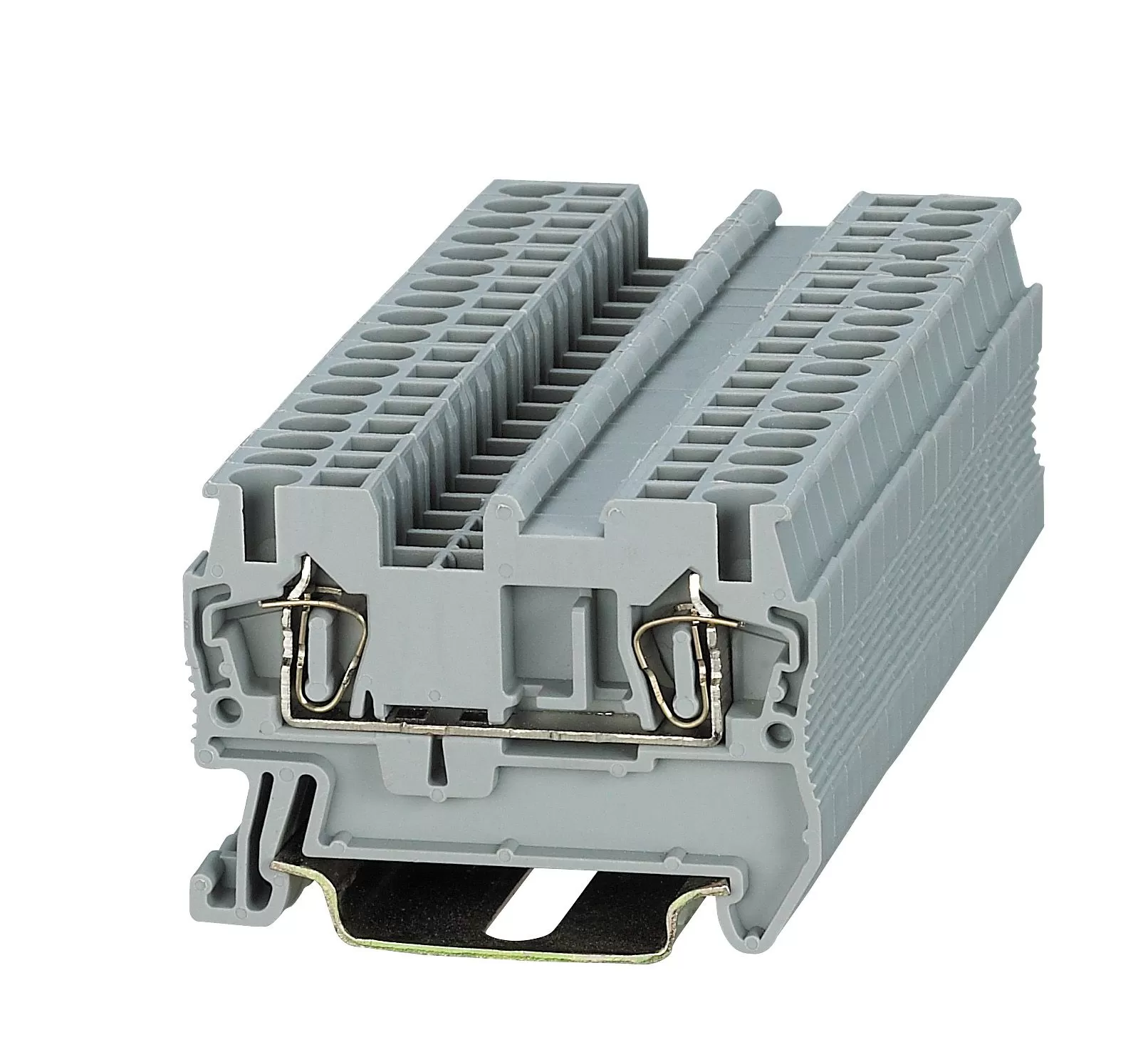
A spring-cage terminal block uses a preloaded spring to maintain conductor pressure as temperature and conductor dimensions change. A useful definition also identifies the boundary of the category, separating a Spring-Cage Terminal Block from similar-looking connection or mounting systems.
Stainless steel spring cage clamps the wire
Separate the material family from the exact alloy or resin grade. Conductivity, strength, temperature, flame behavior and corrosion performance can change with grade, plating, molding and finished geometry. Confirm the result on a production-representative sample before releasing tooling or volume orders.
Actuated by a screwdriver to open/close
The mechanism must create stable contact pressure without damaging the conductor or hardware. Specify the tool, preparation method and model-specific torque or spring procedure, then inspect full insertion. Do not copy the value from a neighboring series unless the manufacturer documents the same construction and approval.
How the Spring Maintains Constant Pressure
This section explains how the spring maintains constant pressure and identifies the values that need to be fixed on the drawing, datasheet or RFQ. A change in one value can alter fit, rating or service access.
Preloaded spring compensates for thermal cycling
Review how the clamp compensates for strand settlement, vibration and thermal movement. The installation instruction should define tool access, release method and inspection points. Vibration performance must still be established by the product's declared tests and mounting conditions.
No screw re-torque in normal service
Reliability must be evaluated over vibration, thermal cycling and service operations, not only at initial installation. Follow the declared inspection and maintenance instructions for the exact connection technology. Confirm the result on a production-representative sample before releasing tooling or volume orders.
Connection Technology Snapshot
| Technology | Contact-force source | Typical advantage |
|---|---|---|
| Screw | Specified installation torque | Broad familiarity and conductor flexibility |
| Spring-cage | Preloaded spring | Stable pressure under vibration and thermal movement |
| Push-in | Spring deflected by prepared wire | Fast direct insertion for approved conductors |
Performance must be confirmed on the exact model.
Where Spring-Cage Excels
The decisions under where spring-cage excels affect first-time assembly and long-term maintenance. Document them in the bill of materials and installation instructions instead of leaving them to operator judgment.
High-vibration environments: railway, marine, heavy machinery
The datasheet or drawing should identify high-vibration environments and state railway, marine, heavy machinery. Reliability must be evaluated over vibration, thermal cycling and service operations, not only at initial installation. Follow the declared inspection and maintenance instructions for the exact connection technology. Do not copy the value from a neighboring series unless the manufacturer documents the same construction and approval.
Where maintenance access is difficult
Reliability must be evaluated over vibration, thermal cycling and service operations, not only at initial installation. Follow the declared inspection and maintenance instructions for the exact connection technology. A preloaded spring follows conductor settlement and thermal movement without a screw re-torque operation.
Spring-Cage vs Screw vs Push-In
The comparison under spring-cage vs screw vs push-in is most useful when every option is judged against the same circuit and installation conditions. Compare tested ratings, fit, labor and service requirements rather than one isolated feature.
Wiring speed, vibration resistance, cost comparison
Compare the alternatives on the same axes: function, current path, conductor, mounting, rating, service method and approval. Judge both alternatives under the same load, conductor, mounting and service conditions. Similar appearance or one shared dimension does not establish equivalent function or approval. Keep the evidence with the drawing and sample record so purchasing cannot substitute a similar-looking part.
Wire Preparation for Spring Terminals
Treat wire preparation for spring terminals as an engineering check rather than a catalog label. Define the requirement, identify the governing rating and verify it on the exact product variant.
Ferrules recommended for stranded wire
Keep wire size, conductor class and termination method on one datasheet row. If two conductors or a lug are involved, verify that exact combination instead of relying on physical fit. Keep the evidence with the drawing and sample record so purchasing cannot substitute a similar-looking part.
Solid wire can be inserted directly
Check the bare or ferruled diameter, strip length and insertion depth with the production wire. A nominal mm² or AWG value does not describe strand class or crimp geometry. Vibration performance must still be established by the product's declared tests and mounting conditions.
Related guidance: Terminal Block Types: The Complete Guide with Pictures and Screw vs Spring vs Push-in Terminal Blocks: How to Choose.
Practical Specification Workflow
Start with the circuit and installation rather than a preferred part number. Record the required function, conductor construction, continuous and abnormal current, system voltage, ambient temperature, enclosure, mounting and target-market approval. Translate every catalog phrase into a value or drawing reference that purchasing and quality teams can verify.
Next, compare candidate datasheets line by line. Keep each current or voltage value paired with its conductor, test standard and environmental condition; do not combine the most favorable values from different rows or variants. A preloaded spring follows conductor settlement and thermal movement without a screw re-torque operation.
Finally, test a production-representative sample with the actual wire, tool, accessory and mounting. Check insertion, torque or operation, pull security, spacing, labeling and service access. Photograph the approved assembly and retain the datasheet revision so later substitutions can be evaluated against the same baseline.
FAQ: Frequently Asked Questions
Are spring terminal blocks better than screw?
They are better where vibration resistance, stable spring pressure or freedom from screw re-torque is important. Screw blocks may still be preferable for cost, field familiarity or conductor flexibility.
Do spring cage terminals need ferrules?
It depends on the conductor and terminal approval. Solid wire may not need one; fine-stranded wire often benefits from a correctly crimped ferrule. Follow the declared conductor range.
Can spring terminal blocks come loose?
A correctly installed approved spring terminal is designed to maintain pressure, but incomplete insertion, wrong wire size, damaged springs, contamination or an unsuitable mounting environment can still cause failure.
Next Steps: Choosing the Right Terminal Block
Turn the guide into a short specification before requesting a quotation. Record the exact function, conductor, electrical ratings, dimensions, mounting, environment, accessories and destination-market approvals, then evaluate a sample in the real assembly.
Browse relevant products — compare complete terminal blocks and connectors catalog and feed-through terminal blocks.
Request the full catalog and drawings — keep the exact item number, revision, dimensions, ratings and accessory list together.
Evaluate production-representative samples — use the actual wire, ferrule or lug, tool, mounting and enclosure conditions.
Send a complete RFQ to engineering — include current, voltage, conductor, environment, quantity, approvals and any OEM/ODM requirements.
Antong has manufactured terminal blocks since 1989, operating a 55,000 m² production facility with ISO 9001 quality management and shipping to 70+ countries. Product parameters and certifications vary by exact model; request the current datasheet and approval evidence before releasing the bill of materials.
Continue reading
References & standards
IEC 60947-7-1, Low-voltage switchgear and controlgear — Part 7-1: Ancillary equipment — Terminal blocks for copper conductors — webstore.iec.ch
IEC 60068-2, Environmental testing — vibration, shock and temperature test series — webstore.iec.ch
WAGO Material Specifications, PA66, PBT and PC insulation-material properties — www.wago.com
Antong product documentation, Terminal blocks, brass bars, factory and quality information — www.safetypass.com
Technical content prepared by the Antong Engineering Team from 35+ years of terminal block manufacturing experience. Values, compatibility and approvals must always be confirmed against the exact product datasheet and applicable installation standard before design release.