
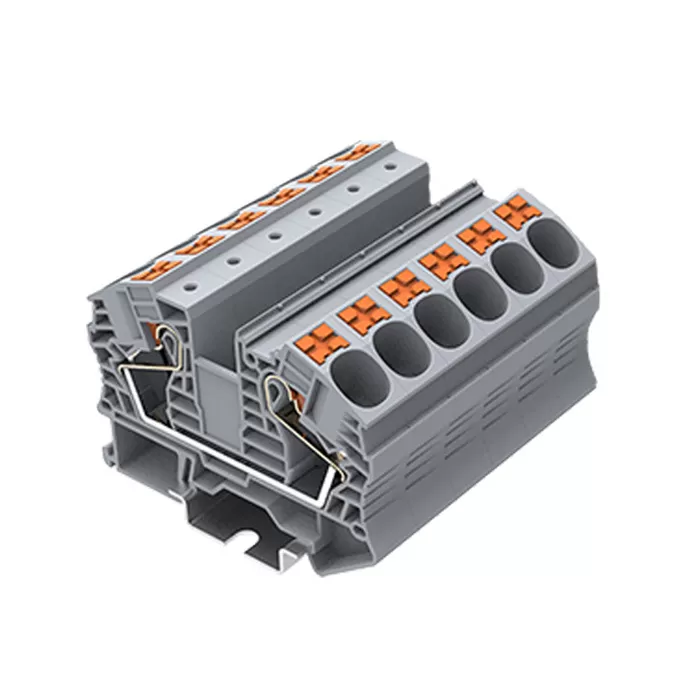
Push-In Terminal Blocks: Speed and Reliability | SafetyPass
Push-In Terminal Blocks: Speed and Reliability for Panel Builders
Antong catalogue scope: SP017 is described as a push open-close connector, with 2- and 3-pole models for up to 1.5 mm², 6 A and 250 V. That description does not establish every direct push-in conductor combination or a DIN-rail push-in product range. Check the actual operating instructions.
Antong product selection reference · Updated 24 October 2026
Selecting the right push in terminal block requires more than matching a familiar catalog name. Products in the same category can differ in current path, conductor interface, material, dimensions, mounting and approval conditions.
For high-volume panel shops and OEMs, that distinction affects initial design, purchasing, assembly and later maintenance. This guide follows the original brief from construction through ratings, applications and practical checks so the same evidence can support the RFQ, sample approval and inspection record.
From more than 35 years of manufacturing terminal blocks, the consistent lesson is that reliability comes from matching the complete application rather than one attractive number. Push-in is spring technology optimized for direct insertion of approved rigid or ferruled conductors.
Quick answer: Push-in technology allows an approved solid or ferruled conductor to deflect a spring and seat without a separate opening tool. It can accelerate repetitive panel wiring, but unferruled fine-stranded wire, incorrect ferrules, very large conductors and low-volume cost priorities can remove the advantage.
In this guide
What Is Push-In Technology?
Push-in technology allows an approved solid or ferruled conductor to deflect a spring and seat without a separate opening tool. A useful definition also identifies the boundary of the category, separating Push-In Technology from similar-looking connection or mounting systems.
Spring-loaded contact opens for direct insertion
Review how the clamp compensates for strand settlement, vibration and thermal movement. The installation instruction should define tool access, release method and inspection points. Keep the evidence with the drawing and sample record so purchasing cannot substitute a similar-looking part.
Solid wire or ferruled stranded wire inserts without tools
Evaluate the actual conductor construction and prepared end, not only its nominal gauge. The approved range can differ for solid, stranded, fine-stranded, ferruled and multi-conductor combinations. Keep the evidence with the drawing and sample record so purchasing cannot substitute a similar-looking part.
Wiring Time Savings: Real Benchmarks
This section covers wiring time savings, specifically real benchmarks. Keep every value tied to the exact model and the conditions stated in its drawing or datasheet.
Seconds per connection vs screw terminals
Compare the alternatives on the same axes: function, current path, conductor, mounting, rating, service method and approval. Judge both alternatives under the same load, conductor, mounting and service conditions. Similar appearance or one shared dimension does not establish equivalent function or approval. Wiring-time claims depend on wire preparation, operator method, accessibility and whether release operations are included.
Labor cost impact for 1,000+ connection panels
Measure total installed space and labor rather than unit size or price alone. Higher density can increase heat, routing effort and service time, while a more expensive interface can reduce assembly or replacement cost. Keep the evidence with the drawing and sample record so purchasing cannot substitute a similar-looking part.
Push-In Process Comparison
| Conductor | Typical insertion method | Preparation risk |
|---|---|---|
| Solid | Direct push-in when approved | Wrong diameter or strip length |
| Ferruled stranded | Direct push-in when approved | Bad crimp or oversized collar |
| Unferruled fine-stranded | Operate spring with tool | Splayed or incomplete strands |
Follow the product's approved conductor combinations.
When Push-In Makes Sense
Evaluating when push-in makes sense requires both product data and installed conditions. Keep each catalog value paired with the exact model, conductor, mounting and approval to which it applies.
High-volume panel manufacturing
State the requirement in terms that engineering, purchasing and inspection can all verify. If the catalog does not provide the needed value, request a drawing or test record before approval. Confirm the result on a production-representative sample before releasing tooling or volume orders.
PLC and I/O wiring with ferrules
Review one complete field-device circuit first, then repeat it across the terminal row. The power commons need aggregate-current checks, while signals need point-by-point identification. Push-in is spring technology optimized for direct insertion of approved rigid or ferruled conductors.
Repetitive wiring tasks
Use the point to eliminate unsuitable variants, then confirm the remaining choice on the exact datasheet and sample. Similar naming is not evidence of equivalent construction. Do not copy the value from a neighboring series unless the manufacturer documents the same construction and approval.
When Push-In Doesn't Fit
Treat when push-in doesn't fit as an engineering check rather than a catalog label. Define the requirement, identify the governing rating and verify it on the exact product variant.
Unferruled stranded wire (requires tool to open)
Check the bare or ferruled diameter, strip length and insertion depth with the production wire. A nominal mm² or AWG value does not describe strand class or crimp geometry. Do not copy the value from a neighboring series unless the manufacturer documents the same construction and approval.
High-current applications above ~35mm²
Treat the stated millimeter value as one nominal dimension or conductor class; verify the complete tolerance and profile drawing. These are conductor cross-section classes, not interchangeable terminal ratings. Match each size to its own wire range, current, voltage and clamp data on the exact product row. Wiring-time claims depend on wire preparation, operator method, accessibility and whether release operations are included.
Cost-sensitive low-volume projects
Measure total installed space and labor rather than unit size or price alone. Higher density can increase heat, routing effort and service time, while a more expensive interface can reduce assembly or replacement cost. Record the accepted condition in the terminal schedule so installers and inspectors use the same basis.
Push-In vs Spring-Cage: The Difference
This section covers push-in vs spring-cage, specifically the difference. Keep every value tied to the exact model and the conditions stated in its drawing or datasheet.
Both use springs but actuation differs
Compare the alternatives on the same axes: function, current path, conductor, mounting, rating, service method and approval. Judge both alternatives under the same load, conductor, mounting and service conditions. Similar appearance or one shared dimension does not establish equivalent function or approval. Keep the evidence with the drawing and sample record so purchasing cannot substitute a similar-looking part.
Push-in = tool-free insertion; spring-cage = screwdriver actuation
Connection reliability comes from controlled contact force and a clean interface. Match the wire preparation and operating method to the exact clamp rather than tightening or pushing by feel. Push-in is spring technology optimized for direct insertion of approved rigid or ferruled conductors.
Related guidance: Terminal Block Types: The Complete Guide with Pictures and Screw vs Spring vs Push-in Terminal Blocks: How to Choose.
FAQ: Frequently Asked Questions
Are push-in terminal blocks reliable?
Yes, within their declared conductor, current, voltage and environmental ratings. Reliability depends on full insertion, correct strip length, an approved ferrule where required and an undamaged spring contact.
Can you use stranded wire in push-in terminals?
Yes, but fine-stranded wire generally needs a ferrule for direct push-in or the operating button/tool must open the spring. Check the exact product instructions.
Do push-in terminals accept ferrules?
Many do, provided the ferrule type, crimp profile and size fall within the approved range. Oversized collars or poor crimps can prevent full insertion.
Next Steps: Choosing the Right Terminal Block
Turn the guide into a short specification before requesting a quotation. Record the exact function, conductor, electrical ratings, dimensions, mounting, environment, accessories and destination-market approvals, then evaluate a sample in the real assembly.
Browse relevant products — compare complete terminal blocks and connectors catalog and feed-through terminal blocks.
Request the full catalog and drawings — keep the exact item number, revision, dimensions, ratings and accessory list together.
Evaluate production-representative samples — use the actual wire, ferrule or lug, tool, mounting and enclosure conditions.
Send a complete RFQ to engineering — include current, voltage, conductor, environment, quantity, approvals and any OEM/ODM requirements.
Antong’s catalogue traces the business to Zhejiang Antong Electric Co., Ltd., established in 1989; Zhejiang Antong Elec & Tech Co., Ltd. was founded in October 2011. Compare the exact product model, material, rating and drawing before ordering. Request current, model-specific compliance documents where required.
Continue reading
References & standards
IEC 60947-7-1, Low-voltage switchgear and controlgear — Part 7-1: Ancillary equipment — Terminal blocks for copper conductors — webstore.iec.ch
WAGO Material Specifications, PA66, PBT and PC insulation-material properties — www.wago.com
Antong product documentation, Terminal blocks, brass bars, factory and quality information — www.safetypass.com
Technical content prepared by the Antong Engineering Team from 35+ years of terminal block manufacturing experience. Values, compatibility and approvals must always be confirmed against the exact product datasheet and applicable installation standard before design release.