
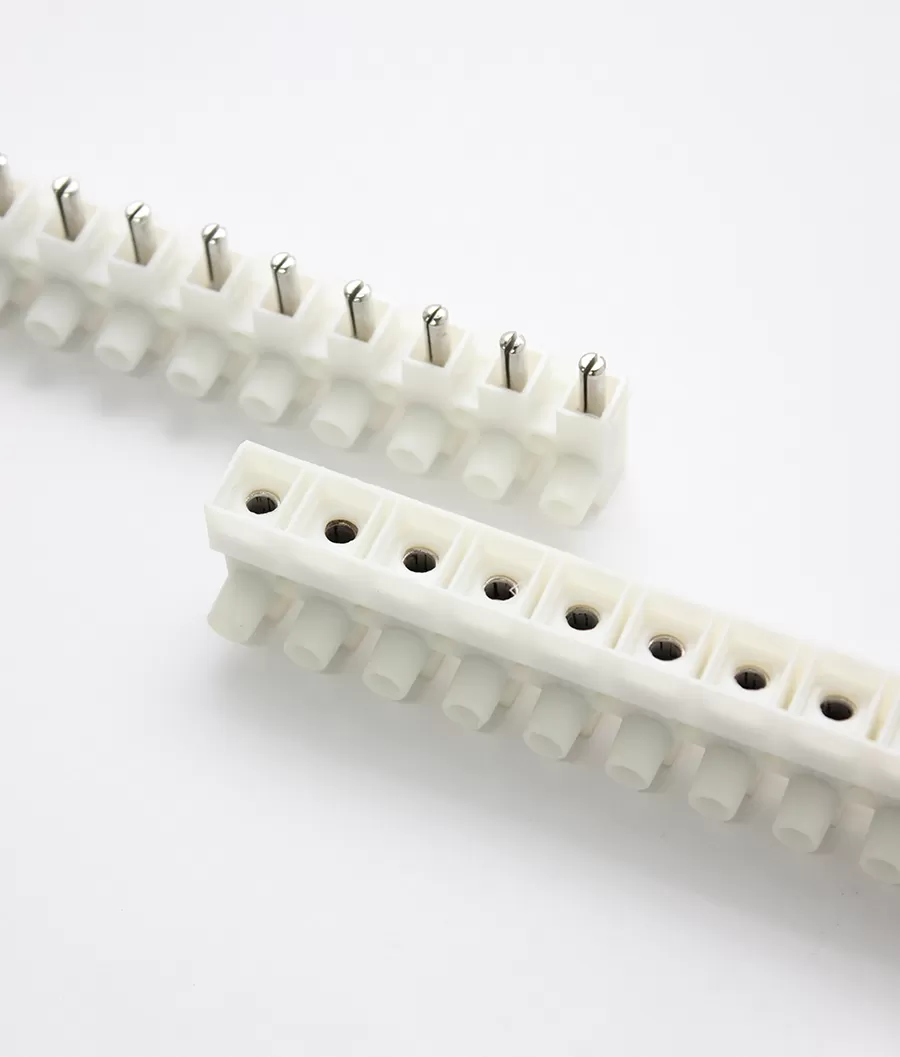
Terminal Block RFQ Template: Separate Confirmed Specs from Open Questions
An enquiry can take longer to quote when confirmed choices and open questions appear in one list. Without clear status labels, a supplier may need to clarify the requirement before pricing the proposed item.
This guide gives a field list for a terminal block RFQ that separates the two, and it can be copied into an email or a spreadsheet. Terminal block families are listed in the product range.
Quick answer: Split the enquiry into three blocks: what is confirmed (and to which drawing or standard), what is open (and who will decide it), and what is commercial (quantity, units, packaging, delivery). This helps the supplier price the confirmed scope, identify assumptions and list questions that may affect selection, price or delivery.
In this guide
- Why RFQs stall
- Confirmed, open and commercial
- The field list
- Quantities and units
- Samples, drawings and approval
- FAQ: Frequently Asked Questions
- Next steps: send the filled form
Why RFQs stall
The following gaps can add another round of clarification.
- A part number with no quantity. The supplier may identify the item, but a useful quotation normally needs an order quantity and its unit.
- A specification with no source. "2.5 mm², 32 A" may come from a drawing, a similar part or an estimate, and the answer differs in each case.
- A mixture of levels. When product choices, packaging preferences and delivery requests are mixed, the reply may not make clear which assumptions support the price.
- Hidden decisions. The buyer intends to confirm the approval requirement later, and the supplier prices without it, so the quote changes afterwards.
Confirmed, open and commercial
| Block | What belongs in it | How it is answered |
|---|---|---|
| Confirmed | Values you have already fixed, with their source | Quoted directly |
| Open | Questions you intend to resolve, with the decision date | Clarified before final selection; any provisional price states its assumptions |
| Commercial | Quantity, unit of measure, packaging, delivery terms, destination | Quoted against your terms |
Keeping the blocks separate has a second benefit: when the quotation arrives, it is obvious which lines were answered and which were assumed.
The field list
| Field | Example of a usable entry |
|---|---|
| Product type or family | Feed-through terminal block, screw clamp |
| Part number | If you have one; otherwise state "to be specified from the data below" |
| Pole configuration | Number of poles or ways, and whether the arrangement is defined |
| Pitch | Value and where it comes from, such as the existing assembly |
| Conductor range | Cross-sections and strand types, including whether ferrules are used |
| Current and voltage | Application values, with the circuit or the standard they come from |
| Mounting | Rail profile or panel fixing, and how the block is retained |
| Material of the housing | Grade if fixed, or state "to be advised" |
| Screw or clamp type | Screw head type and driver size, if already standardised |
| Marking | Whether marking, colour coding or printing is required |
| Environmental conditions | Temperature, moisture, chemicals, indoor or outdoor |
| Certification or market | Which approvals the destination market requires |
| Drawing or standard | The document the confirmed values come from, with revision |
| Packaging | Bulk, branded box or retail packaging, and labelling requirements |
| Quantity | Per item, with the unit of measure stated |
| Delivery | Incoterms, destination and any requested date |
| Sample requirement | Whether a sample is needed before production, and what it will be checked against |
Quantities and units
Quantity errors are avoidable, and they are expensive when discovered after production.
- State the unit. Pieces, poles, metres, boxes or cartons are different units, and "1,000" is meaningless without one.
- Convert to the supplier's unit. Where the product is supplied in standard packs, give the pack count and the total.
- Say whether the quantity is fixed. A change in quantity may affect price, packaging or production planning.
- Separate the sample quantity from the production quantity.
- State the order pattern. A single delivery and a scheduled call-off are quoted differently.
Samples, drawings and approval
Where a sample is required, say what it will be checked against before it arrives.
- State the reference: your drawing, the supplier's drawing, or a physical sample of the existing part.
- Say what will be measured, and by whom.
- Give the time allowed for evaluation, since it affects the delivery schedule.
- Say what happens after approval: whether approval of a sample releases the production batch, and whether the batch is expected to be identical.
- Ask for the drawing of the supplied item, so the approved configuration is documented rather than remembered.
FAQ: Frequently Asked Questions
What should a terminal block RFQ contain?
It should contain the product family or part number, the pole configuration, conductor range, application current and voltage, mounting, environmental conditions, quantity with its unit, packaging, delivery terms and any certification requirement. Values that are already fixed should be marked as confirmed and referenced to a document; the rest should be listed as questions.
Why do suppliers ask so many questions about quantity and units?
Because price, tooling and packaging all depend on them. A quantity expressed in pieces, poles or packs leads to three different quotations, and the unit determines whether standard packing can be used. Stating the unit and the total removes an entire round of clarification.
How do I know whether a quoted part matches my requirement?
Ask for the drawing of the quoted item and compare it with your own values, field by field, before ordering. Where a sample is supplied, check it against the same drawing and record the result, so the approved configuration is documented and can be ordered again.
Next steps: send the filled form
A filled form is faster than a series of messages.
- Send the confirmed values with their source document and revision.
- List the open questions separately, so they are answered rather than assumed.
- State quantities with units, packaging and delivery terms.
- Say what a sample will be checked against, if one is required.
- Ask for the drawing of the quoted item, so your file and the supplier's file agree.
- Browse the full catalogue — start from the product range and the feed-through terminal block family.
Antong manufactures terminal blocks and electrical connection products, and quotes against a written requirement. Because dimensions, conductor ranges and materials differ between series, a complete requirement list is what allows the correct item to be confirmed. Send your filled form through the contact page.
Continue reading
- How to Choose Terminal Blocks: Current, Wire Size & Pitch
- Terminal Block Terminology: Glossary for Buyers & Engineers
References & standards
- ISO 9001 describes quality management system requirements. Refer to it where relevant to the purchasing process; its name does not establish a terminal block's electrical rating or product approval.
- IEC 60947-7-1 covers certain copper-conductor terminal blocks with screw or screwless clamping for industrial or similar use. Confirm whether the proposed model is assessed to this standard and which edition applies; use the actual product documentation for its declared ratings.
- Antong product documentation — request the current datasheet and drawing for the quoted model, with the revision identified. Start from the product range when the family is not yet fixed.
Before ordering, confirm the exact model, drawing revision, applicable standards and any required approvals with the supplier. This field list is a purchasing aid, not a declaration that a particular product holds a certification.