
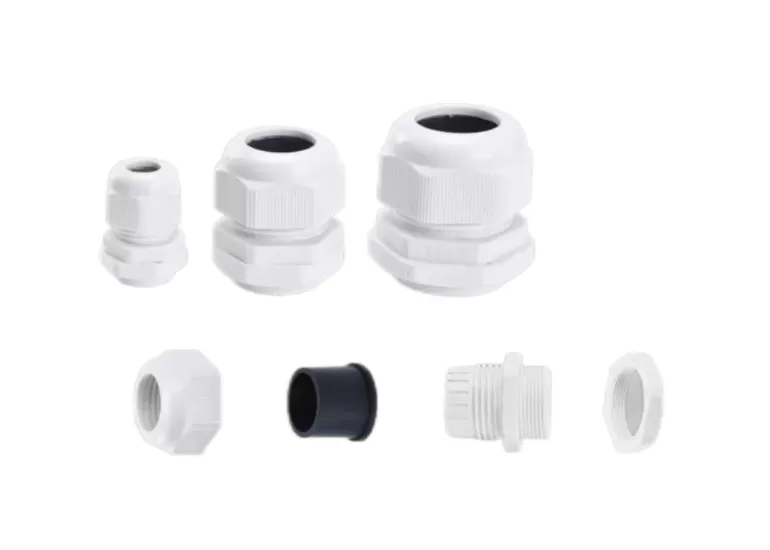
Cable Gland vs Grommet vs Cable Clamp: Choose by Function
The three parts appear together in catalogues and are frequently substituted for one another. They do different jobs. A cable gland holds and seals a cable where it passes through a wall. A grommet protects the cable from the edge of a hole. A clamp supports or fixes the cable along its route. Choosing by appearance rather than by function is how panels end up with a gland used as a clamp or a hole left unprotected.
This guide sets out the three functions, what each part does not do, and how to specify a panel entry so the right combination arrives. The products are in the cable accessories range.
Quick answer: Decide by the failure you are preventing. Water or dust entering the enclosure needs a gland with a declared assembly. A cable rubbing on the cut edge of a hole needs edge protection. A cable that must be held or supported along its route needs a clamp. Check the declared functions of the selected item and add the support or edge protection required along the route.
In this guide
- Three separate jobs
- What each part does not do
- Combinations that work
- Common mismatches
- What to send to specify an entry
- FAQ: Frequently Asked Questions
- Next steps: describe the failure
Three separate jobs
| Product | Function | Where it is used |
|---|---|---|
| Cable gland | Clamps the cable and seals where it passes through a wall | Panel and enclosure entries that require a seal |
| Basic open grommet or edge protector | Protects the cable jacket from a hole edge or a sharp opening | Openings where the cable passes without sealing |
| Cable clamp or clip | Holds or supports the cable along its route | Cable runs, trays and panels |
Sealing, edge protection and support are separate requirements, even when a product combines them. A conventional cable gland addresses the entry, while a basic open grommet protects an edge. Some membrane grommets also provide declared sealing, and certain designs provide cable retention. WISKA's membrane-entry examples illustrate sealing grommets used in specified enclosure arrangements. Check the selected product's documentation for the functions and installation conditions it covers.
What each part does not do
- A basic open grommet provides edge protection. A sealing or membrane grommet needs a declared protection level and an assembly suited to the cable and panel.
- A clamp does not seal. It holds the cable; the opening it passes through remains open.
- A gland does not replace support along a run. The gland holds the cable at the entry; the run still needs support where its own weight or movement requires it.
- A gland's strain relief capability depends on the product. Where the application requires the cable to resist pull, that has to come from a product and an assembly declared for it.
- Neither a clamp nor a grommet provides a protective bonding connection unless the item is declared for that purpose.
Combinations that work
| Requirement | Usual combination |
|---|---|
| Sealed entry into an enclosure | Gland with the correct seal for the cable diameter, plus the panel-side parts the mounting method needs |
| Cable passing through a panel opening with no sealing | Basic open grommet or edge protector, with a clamp nearby to hold the cable |
| Long cable run between enclosures | Clamps or clips at intervals, with glands at the ends where sealing is required |
| Sealed entry plus pull resistance | A gland and assembly declared for the duty, plus support for the run |
| Cable entering a moving part | Routing declared for movement, with support and edge protection as designed |
Common mismatches
- A gland ordered for a hole, not for a cable. The thread suits the opening but the clamping range does not suit the jacket.
- An open edge-protection grommet used where sealing is required. Check for a declared seal and any required cable retention as separate selection criteria.
- A clamp used as a gland. The cable is held, but the entry is not sealed and the clamp may damage a soft jacket if tightened to grip.
- A gland used to carry the run's weight. The gland is not a support, and a heavy cable hanging from it loads the entry.
- Edge protection assumed from the gland. Where the cable also passes through another opening along its route, each edge needs its own protection.
- Support assumed from the enclosure. Confirm support positions and bend radius around changes of direction using the cable and entry manufacturers' instructions.
What to send to specify an entry
| Item | Why it is needed |
|---|---|
| Cable type and measured outside diameter | Decides the clamping range and the seal |
| Opening type and size | Threaded hole, clearance hole or open edge |
| Panel material and thickness | Decides the mounting method and the parts required |
| Environment | Whether sealing is required, and against what |
| Pull or movement at the entry | Whether a declared strain relief arrangement is needed |
| Route and support points | Where clamps or clips are required along the run |
| Any other openings on the route | Where edge protection is needed |
| Bonding requirement | Whether any part must form part of a protective bonding arrangement |
FAQ: Frequently Asked Questions
Can a grommet be used instead of a cable gland?
A basic open grommet provides edge protection. When selecting a sealing or membrane grommet, check its declared ingress protection, cable diameter, panel fit and retention capability against the application. Choose the entry system that meets the complete requirement, including any separate support needed along the run.
Does a cable gland provide strain relief?
Some glands and some assemblies are declared for that duty and some are not, and the capability depends on the product and on how it is installed. Where the application requires the cable to resist pull, state the requirement and ask for a product and an assembly declared for it, rather than assuming that any gland performs that job.
Can a cable clamp be used for an earthing connection?
Only if the product is declared for that purpose. A clamp holds a cable mechanically, and whether it can form part of a protective bonding arrangement depends on the item and on the installation requirements, which have to be confirmed rather than assumed from the fact that the clamp is metal.
Next steps: describe the failure
Describe what has to be prevented, and the part follows.
- Say whether the opening must be sealed, and against what: splash, jets or immersion.
- Describe the opening: threaded, clearance hole or open edge, with the panel material and thickness.
- Give the cable type and measured outside diameter.
- Say whether the cable must resist pull, move, or be supported along the route.
- List any other openings along the route that need edge protection.
- Browse the full catalogue — see the cable glands, the cable clamps and the rest of the cable accessories in the full product range.
SafetyPass supplies cable glands, clamps and accessories. Because products differ in which functions they combine, state the sealing, retention, support and edge-protection requirements so a suitable arrangement can be confirmed. Send your entry details through the contact page.
Continue reading
References & standards
- IEC 62444 provides requirements and tests for cable-gland construction and performance. Ask which declared properties and installation instructions apply to the selected gland.
- IEC 60529 classifies degrees of protection provided by electrical enclosures. Confirm the required ingress protection for the completed installation using the entry system's declared conditions.
- SafetyPass SP101 cable-gland documentation gives model-specific thread and cable-range information. Confirm the supplied gland, sealing components and installation conditions when selecting a configuration.
Confirm cable diameter, panel fit, sealing components, retention requirements and installation instructions for the exact products being ordered.